Prove each result before it leaves the lab.
The screen where a medical biologist validates results before they reach the doctor: tubes checked against the order, Westgard QC that holds what it cannot vouch for, delta and consistency checks from a versioned rules engine, a critical-value call that cannot be skipped, and releases nobody can rewrite.
Demo — not a medical device — synthetic data only.
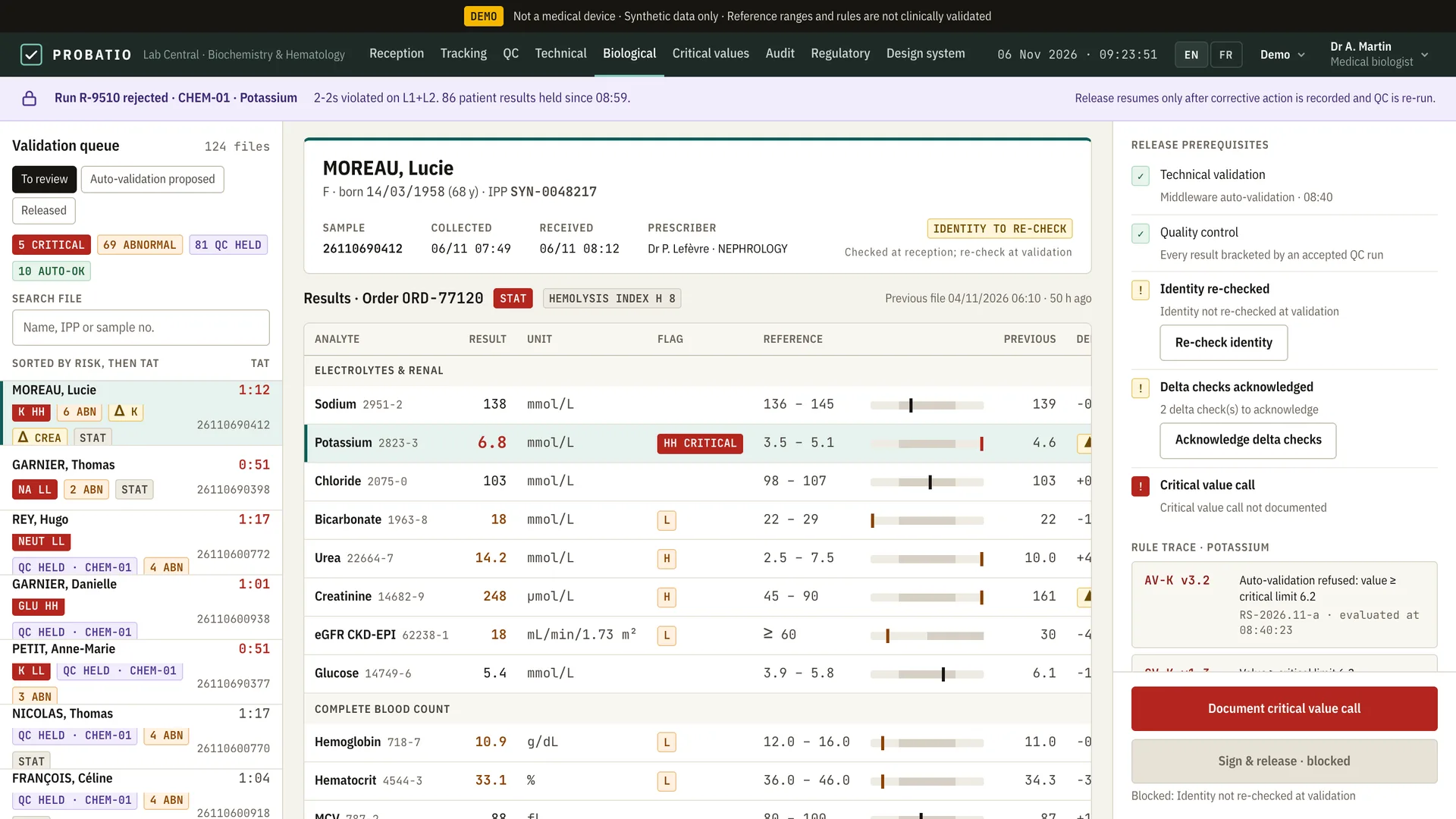
Three thousand tubes a day, one signature each.
A biologist signs off results all day, most of them routine, a few of them urgent. Whether what they sign is right comes down to three things: the patient, the analyzer, the value.
The right patient
A tube's label checked against its order at reception, the identity re-checked before signing, and every action naming the patient it is about — so one file is never validated as another.
An analyzer that can be trusted
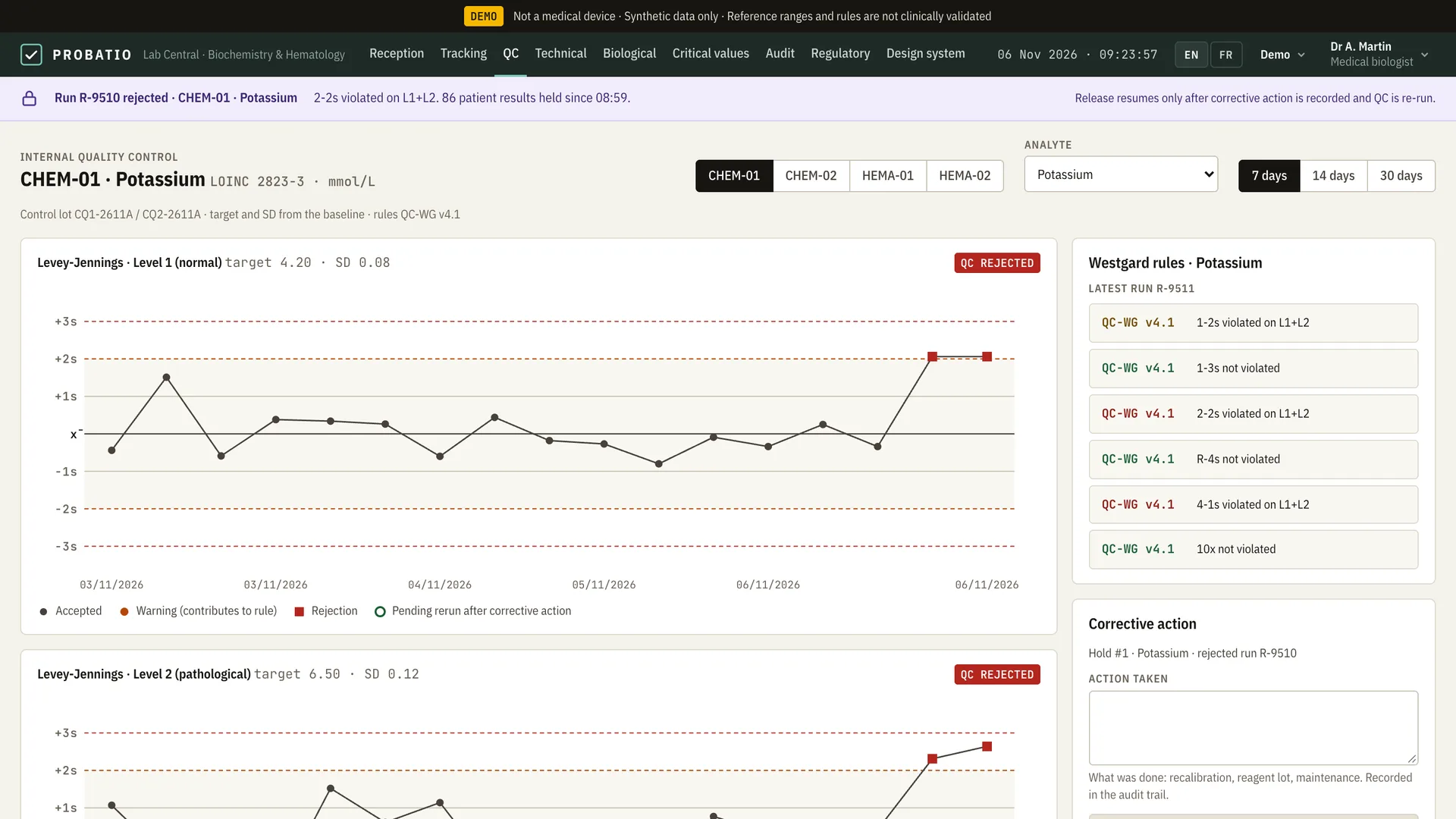
Internal QC on every analyzer and analyte, judged by the Westgard rules, and the results of a failed run held until the analyzer is fixed and re-checked.
A value that makes sense
Each result against its reference, the patient's previous result and the related analytes; the routine proposed for auto-validation, the unusual brought forward, the critical called in.
What the console holds to.
A few rules every screen keeps, enforced by the server and the database, not only shown — because a result released by mistake cannot be called back.
A number never travels alone
Unit, reference interval, analyzer and QC status on every result, and a text flag beside every colour. A result missing one of them is not displayed.
Blocked until it is safe
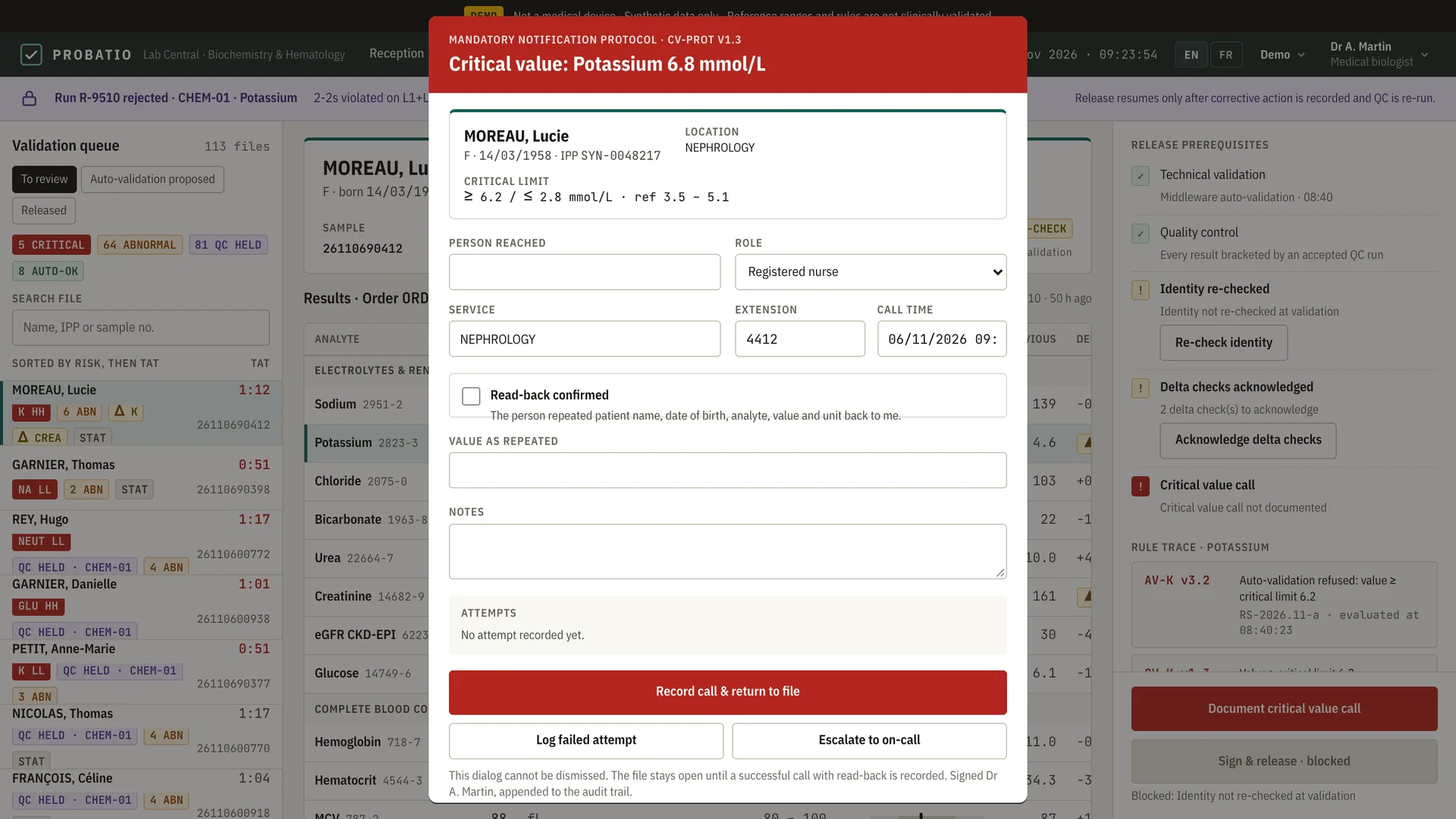
A critical value cannot be released before the call is documented with read-back; a result held by QC cannot be validated; the server refuses what the screen greys out.
Released means released
A released report is immutable in the database itself. A correction is a signed amendment with its reason, and the original stays visible beside it.
A demo, and it says so
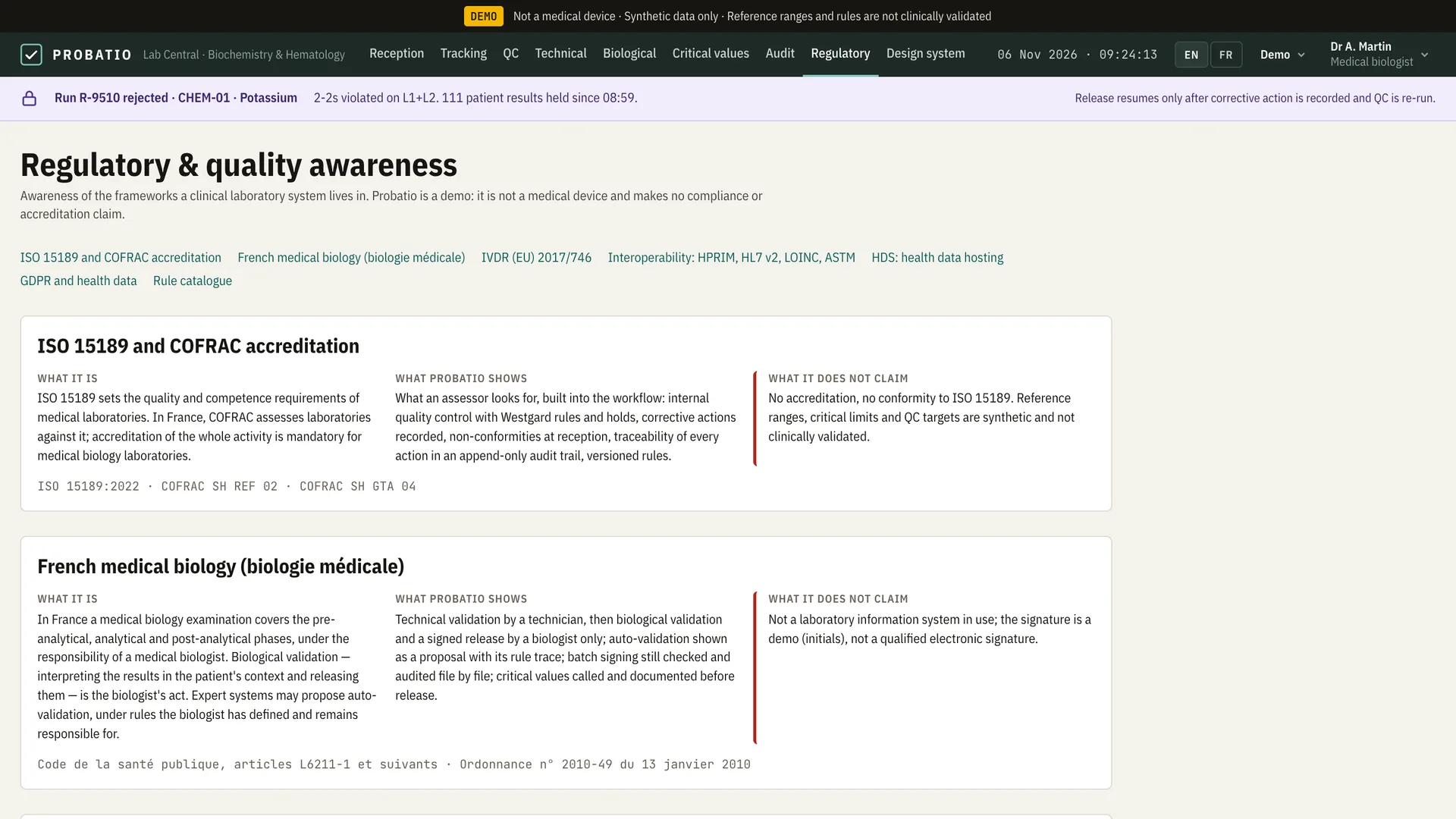
Not a medical device, no compliance claimed, synthetic data only: generated patients and tubes, rule limits labelled as not clinically validated, zero external calls, and a banner on every screen.
Built and running.
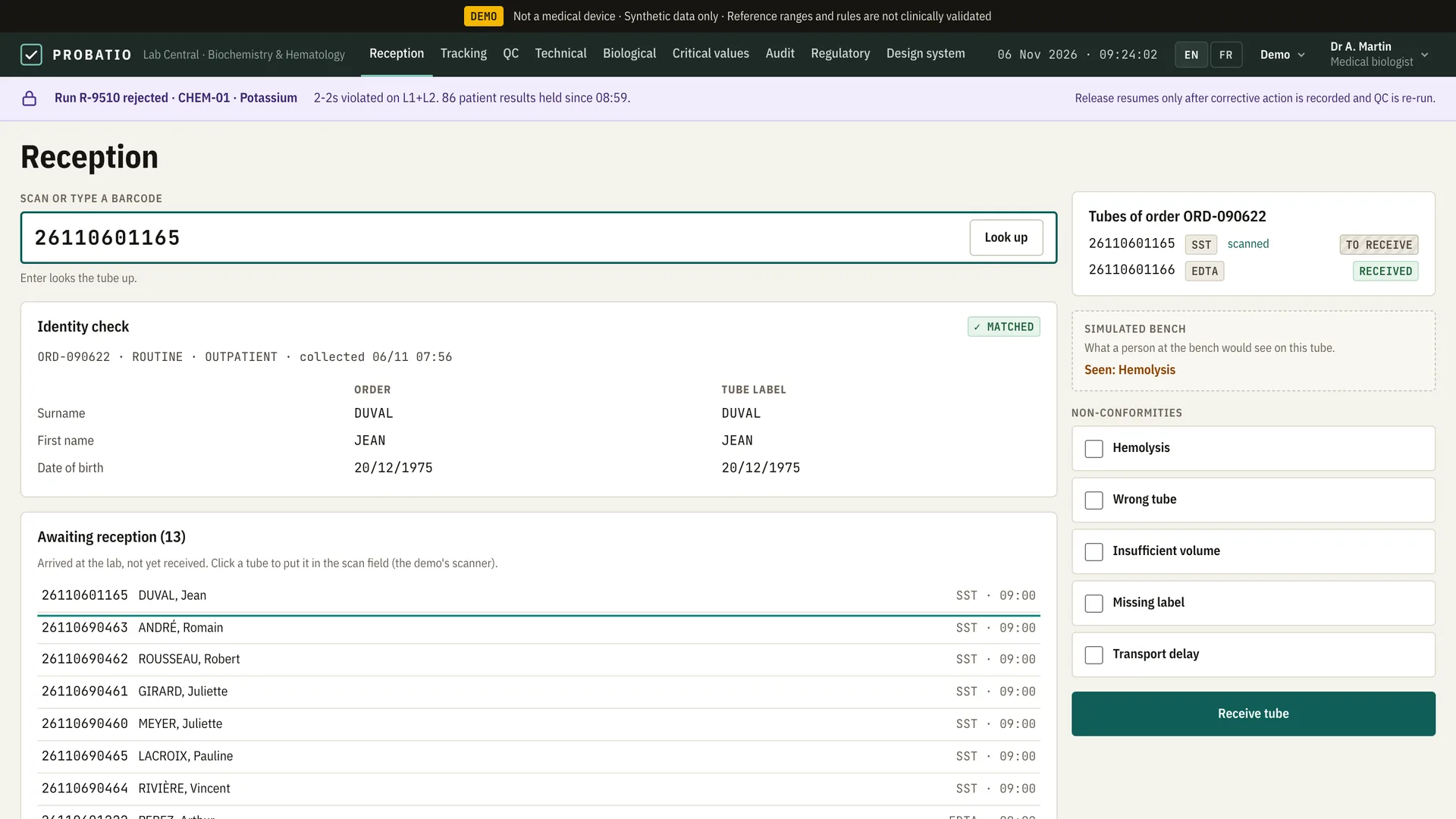
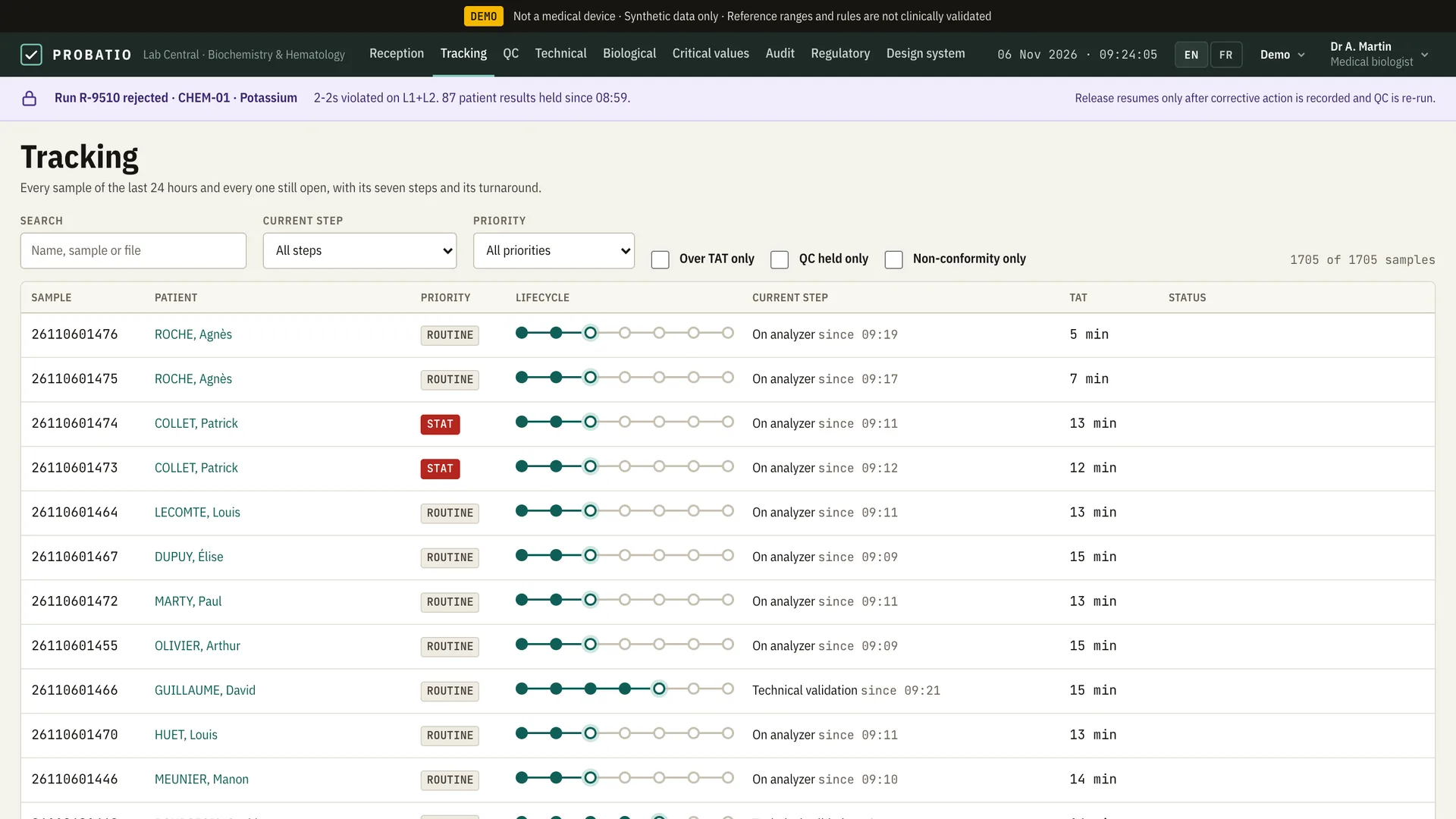
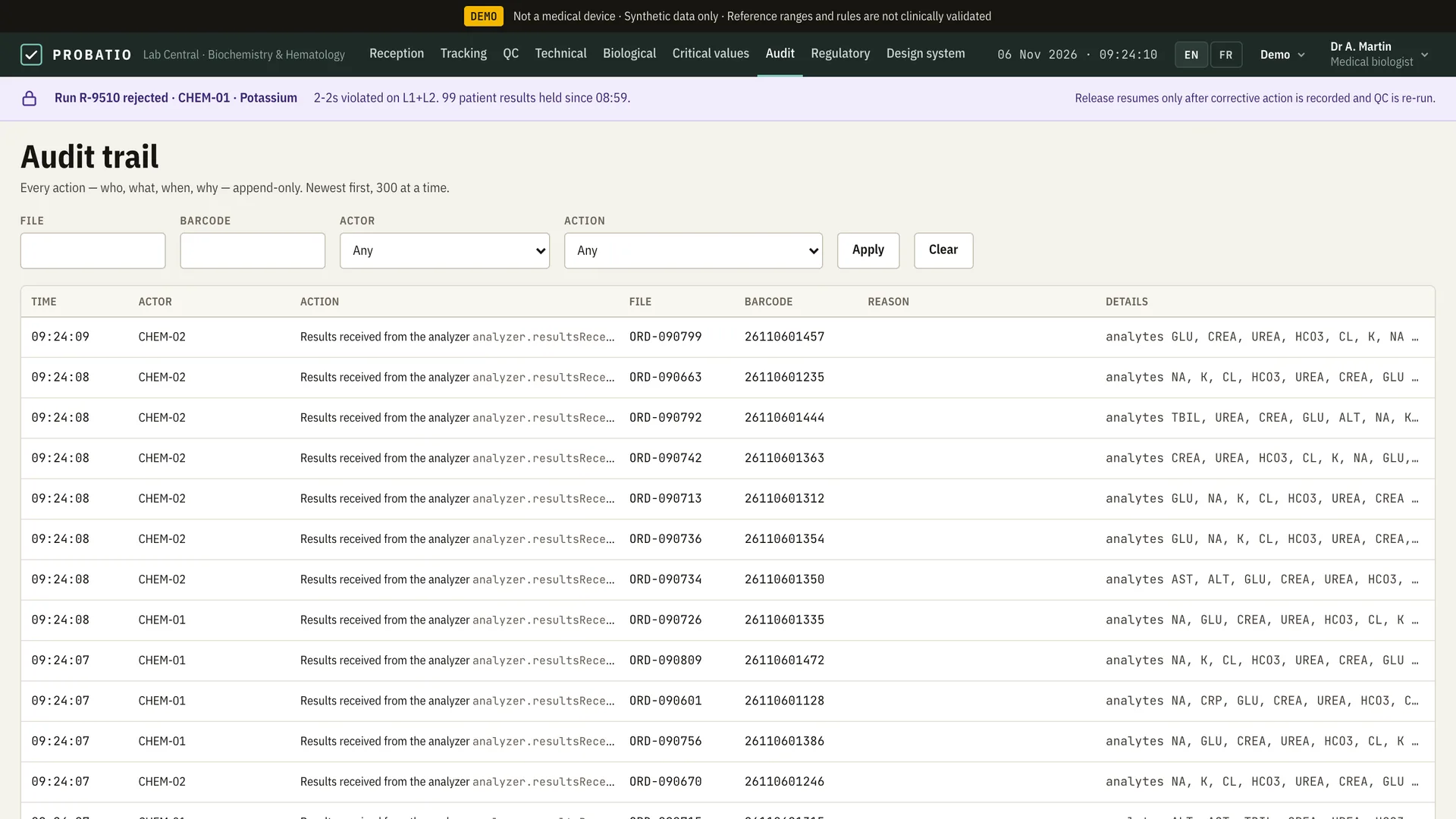
Stills of the live console on its synthetic lab day: the validation screen, the critical-value call, Westgard QC with a hold, reception, the tracking of every tube, the audit trail.
Weighed, chosen, and why.
Each key decision, with the alternatives, the choice and its reason. Each one is written down as a decision record in the repository.
- 01
Writing the rules
- Weighed
- Rules in code · a general rule language · typed rules over a closed set of evaluators
- Chosen
- Rules as data — id, version, kind, parameters — over six evaluator kinds: Westgard, delta, consistency, interference, critical, auto-validation; a published rule set pins one version of each.
- Because
- Every evaluation is stored with the version and the rule set that produced it, so a decision from last month replays exactly; a published rule changed without a new version fails a hash test and a database trigger.
- 02
What a failed QC run holds
- Weighed
- Flag the run only · hold since the run · hold since the last accepted run
- Chosen
- Every unreleased result of that analyzer and analyte since the last accepted run is held, until a corrective action is recorded and a rerun is accepted; then the tubes are measured again.
- Because
- A run that only warned may be the first half of a 2-2s. The database test that proved the hold caught exactly that case.
- 03
Talking to analyzers and the hospital
- Weighed
- In-process fakes · HTTP and JSON · the real wire formats, simplified
- Chosen
- ASTM E1381/E1394 over TCP with frames, checksums, ACK/NAK and retransmission, and HL7 v2 ORM, ORU and ACK over MLLP — codecs written in-house, simulators as separate NestJS services.
- Because
- The simulators reach the lab system only through the wire a real instrument would use; replacing one with a real analyzer changes a mapping, not the workflow.
- 04
Keeping a released report released
- Weighed
- Checks in the API · constraints in the database
- Chosen
- PostgreSQL triggers refuse any change to a released result or report version, and to the audit trail; an amendment is a new version with its reason and the hash of its content.
- Because
- The rule holds whatever code reaches the table, not only the code that remembers it.
- 05
Where the lab day comes from
- Weighed
- Synthea · a fake-data library · an own seeded generator
- Chosen
- A deterministic generator of about 3,000 tubes a day — physiological profiles, patients with history, hemolysis, QC drift, analyzer silences, critical values — replayed up to now through the real workflow.
- Because
- The cases the workflow needs exist on demand, the same seed gives the same day byte for byte, and synthetic colleagues keep the queues alive at any hour.
From the analyzer's frame to the signed report.
Simulated instruments and a simulated hospital system speaking the real wire formats, a lab information system with its rules engine, and a console that only shows what the engine decided.
Simulators
Two NestJS services: four analyzers that take work lists and answer results and QC over ASTM, and a hospital system that sends HL7 orders and receives the released reports over MLLP.
Rules engine
Plain TypeScript shared by every part: the analyte catalog, Westgard multirules, delta and consistency checks, auto-validation, the protocol codecs — 139 tests, the boundary of every rule among them.
Lab system
NestJS 12 on PostgreSQL: orders, tubes, results, QC holds, critical calls, signed releases and amendments, an append-only audit, a projection that keeps the queue one indexed read.
Console and server
Next 16 and React 19 on its own design system, live by server-sent events; PM2 and nginx on my own server, a nightly reset, deploys registered in Zeus and watched by Iknos.
What is built, and what is next.
Live as a demo, built ticket by ticket, each decision written down as it is taken.
Built · analytical
- Reception and trackingBarcode scan, identity against the order, non-conformities with their action, the seven-step lifecycle and turnaround for every tube.
- Quality controlLevey-Jennings charts, the six Westgard rules, holds, corrective actions and reruns.
- Instruments and feedsASTM analyzers and the HL7 hospital system, simulated as separate services on the real wire formats.
Built · validation
- ValidationTechnical and biological validation, the queue ranked by risk, delta and consistency checks, the trace of every rule applied.
- Critical values and releaseThe call protocol with read-back, release signed by the biologist, batch signing of auto-validated files, amendments.
- Audit and regulatoryThe append-only trail, and a page on ISO 15189, COFRAC, biologie médicale, IVDR, HL7 and HDS.
Next
- HPRIMThe French lab format as a second codec behind the same order and result feeds.
- MicrobiologyCultures and susceptibility, a workflow with its own steps and rules.
- Rule authoringA biologist-facing screen to draft a new rule version and publish it as a new rule set.
Validate a file,
on a live synthetic lab day.
Open the critical potassium and try to sign it: the release stays blocked until the ward is called and the value read back. Then record a corrective action on the held QC run, and amend a released result to see the original stay.